
It's the first question almost every collector asks, usually while holding a car they found in a shoebox: is this thing worth anything? The honest answer is "probably not much — but occasionally, a great deal." Hot Wheels have been produced in the billions since 1968, so scarcity is the exception, not the rule. The skill is knowing which details separate a one-dollar car from a four-figure one. Here is how a collector actually reads value.
Start with an honest baseline
The vast majority of Hot Wheels are mainline cars — the inexpensive single carded models you find on a peg at the supermarket. They were made in enormous numbers and, in most cases, they are worth roughly what they cost: a dollar or two. Age alone does not change that. A scuffed loose car from the 1990s is usually still a common car, just an older one. Nostalgia makes a model special to you; it does not, by itself, make it valuable on the open market. Set that expectation first and you'll read the rest of your collection far more clearly.
The five things that decide value
Almost every premium comes down to a combination of these factors:
1. Condition. The single biggest lever. A pristine car still sealed on a crisp, uncreased card is worth multiples of the same car loose and play-worn. 2. Rarity. Limited runs, club exclusives, Treasure Hunts and short-lived variations were simply made in smaller numbers. 3. Desirability. Collectors chase certain castings and licences harder than others — classic VWs, Japanese (JDM) icons, Porsches, Datsuns and popular pop-culture cars command a following. 4. Era. The vintage Redline years (1968–1977) sit in a tier of their own. 5. Demand. A car is only worth what someone will pay today, and tastes move. A casting can heat up when it appears in a film, a game, or a sought-after series.
Carded vs loose: the biggest multiplier
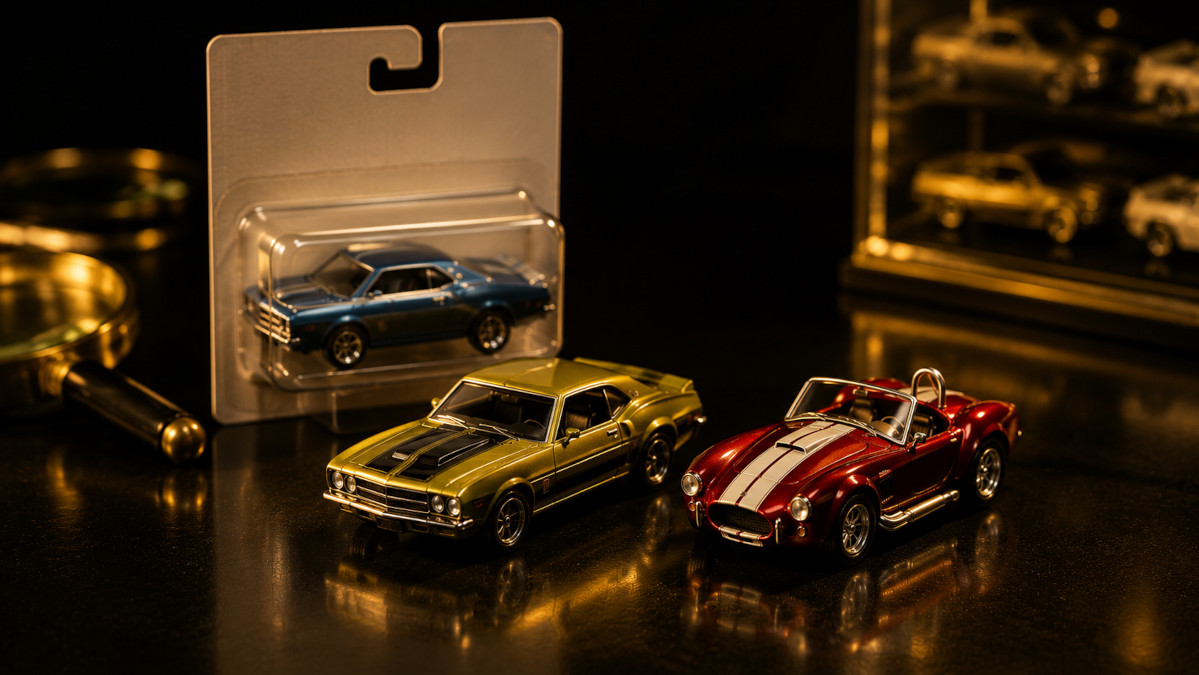
For collectible models, packaging is part of the object. A car that is "mint on card" (MOC) — sealed, with a clean blister and sharp corners — is what serious buyers pay up for. The moment you open it, you've converted a collectible into a toy, and for desirable models that can mean a significant drop in value. This is exactly why you'll see two listings for the "same" car at wildly different prices: one is a graded, sealed example and the other is loose. If a car might be worth something, resist the urge to free it from the card.
Treasure Hunts and Super Treasure Hunts
Introduced in 1995, the Treasure Hunt program seeds special cars into ordinary mainline cases, and they remain the most chased mainline collectibles. There are two tiers, and confusing them costs money. A regular Treasure Hunt (TH) carries a small circled-flame logo. A Super Treasure Hunt (STH) is the premium version — it adds rubber Real Riders tyres and rich Spectraflame paint, and it's the one that genuinely commands a premium. Learning to tell a Super from a regular TH at a glance is one of the most valuable habits a new collector can build.
Errors and variations
Sometimes the valuable car is the "wrong" one. Factory errors — a missing tampo, a crooked print, the wrong wheels, a mismatched base — and early-vs-late colour or wheel variations can turn an otherwise common casting into something collectors actively hunt. Most production quirks are just quirks, but a documented, recognised variation is a different story. When something looks off, don't assume it's damage; check whether it's a known variation first.
How to find what yours is actually worth
Ignore asking prices — anyone can list a car for anything. What matters is what cars actually sell for. On eBay, filter to sold listings for the exact casting, year and condition to see real transactions. Established price guides and collector databases help for vintage pieces. And always compare like for like: carded against carded, loose against loose.
Want the fast answer? Snap a photo and our AI identifies the casting and gives you an instant market-value estimate — free to try. It's the quickest way to triage a whole box of cars.
Check my model's value →One caveat worth repeating: an AI estimate (or any quick lookup) is a guide, not a formal appraisal. For a genuinely rare or high-value piece, get it assessed and, if warranted, professionally graded before you buy or sell.
The bottom line
Most of your collection is probably worth more to you than to the market — and that's completely fine. But the gems are findable once you know what to look for: condition, rarity, the right casting, the right era, and live demand. If you'd like to go deeper, learn how to identify a Hot Wheels casting so you know exactly what you're holding, and see our Hot Wheels Value Guide 2026 for where prices are heading this year.